MINUTES OF SMITHFIELD TOWN COUNCIL WORK SESSION
Date: Tuesday, May 19, 2026
Place: Smithfield Town Hall
Time: 5:30 p.m.
Present:
Town Council President John J. Tassoni, Jr.
Town Council Vice President Angelica Bovis
Town Council Member Michael P. Iannotti
Town Council Member Rachel S. Toppi
Town Council Member Thomas Winfield (excused)
Town Manager Robert Seltzer
Town Solicitor Anthony Gallone
Town Clerk Lyn M. Antonuccio
A. The Smithfield Town Council Work Session is called to order at 5:30 p.m.
B. Discussion Items:
A. Presentation and discussion of BerryDunn Sewer Rate Study.
Town Engineer Joshua Jelley states the following: The Sewer Rate Study has been completed, and after the presentation, he will review the actual report and answer any questions the council may have. This evening he will be requesting that a public hearing be scheduled, and at the
June 2, 2026 council meeting he will be seeking a vote on the rates.
Jesse Myott, a Manager with BerryDunn, is serving as the Project Manager for this
project. He gives the members an overview of the Sewer Enterprise Fund Cost of Service Analysis and Rate Study.
Mr. Myott explains the following: He would like to set the stage and boundaries of their analysis. He did the prior three (3) year study that covered fiscal years 2024, 2025, and 2026. He starts with FY23 to look at past trending to see how the revenue and expense projection are “shaping up” for the last rate cycle. The next year cycle will cover fiscal years 2027, 2028, and 2029.
With those boundaries they look at the total costs of delivering wastewater collection and treatment services to utilize that revenue and expense allocations to establish a cost recovery baseline. This is important because with water and sewer service being an Enterprise Fund, that fund is designed to be self-sustaining, and then some. We want to carry a sufficient fund balance to support business and service continuity should we have to account for some severe downturn or rate smoothing alignment.
He reviews the past performance of the fund going back to FY23 which shows the cost recoveries. Fund balance and other sources account for the additional 15%. Looking at fiscal years 2023 through 2025, there was approximately a 93% cost recovery. This sounds great; however, it is well short of a fund that needs to be self-sustaining. We went to address and correct this so that expenses do not continue to outpace revenues and severely deplete the fund balance.
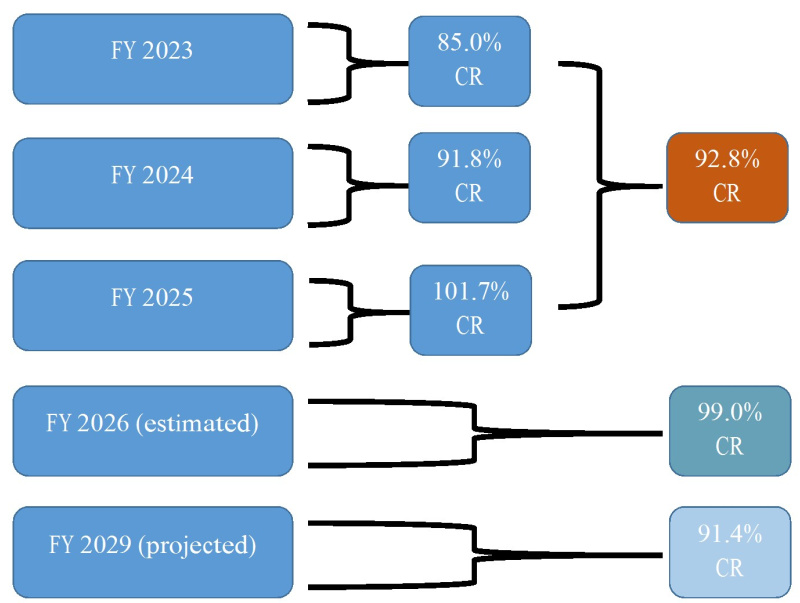
If none of the proposed suggestions are made, the Town would be trending closer to the 91% - 92% cost recovery. Although they have looked at the revenue side, it is more of an expense side driven impact this time around. Things have become more expensive, and there are contractual adjustments that have come into play that are significantly adding to projected expenses going into FY29.
He reviews the high-level core expense drivers.
Veolia Wastewater Treatment Plant Operation Contract:
Cover rising contractual and operating costs: Proposed rate increases reflect higher treatment, collection, labor, energy, and material costs driven by inflation and contractual obligations.
• Increased plant operational (contractual) costs ~$650,000 through FY 2029
• Town now responsible for sludge removal/disposal, ~$360,000 estimated annually (varies, not fixed)
• Town now responsible for police detail / traffic control, camera work, and other expenses
With the core expense drivers having been identified, we want to line that up to be sure that the fund is still moving towards the strategic initiatives, first and foremost, maintaining the sufficient fund balance. This helps on a number of different levels such as mitigating unforeseen circumstances and it also helps on the rate side.
Operations and Maintenance:
• Support critical infrastructure investment: Proposed rates fund necessary reinvestment in aging sewer assets to maintain system reliability and regulatory compliance.
• Operations and maintenance expense increases (inflationary pressures)
• Capital improvements and replacements (fully fund pay-as-you-go capital FY 2027 – FY 2029)
Maintain a Sufficient Fund Balance:
Maintain financial resilience: Adequate rates help sustain a sufficient fund balance to manage emergencies, revenue variability, rate impacts, and unforeseen repairs. (90 days – 120 days target)
• Promote long‑term stability and equity: Gradual, planned increases align costs with current service levels, helping to insulate future ratepayers from deferred liabilities.
Prepare for Future Debt Service Needs:
• Prepare for future debt service needs: Adjustments help ensure the utility can meet existing and anticipated debt obligations without severe rate shocks in future years. The Enterprise Fund is nearing the end of a couple of significant debt obligations.
Support Ratepayer Equity:
• The proposed rate adjustments help ensure the sewer utility remains reliable, compliant, and financially sustainable for todays and future ratepayers.
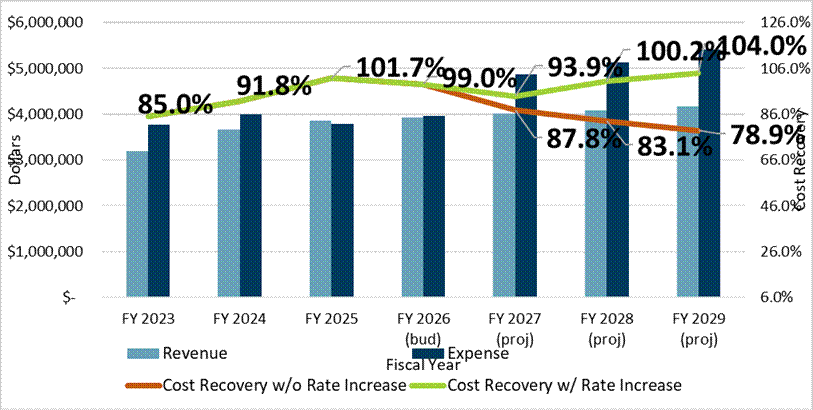
Wastewater Collection & Treatment Services: FY 2023 – FY 2029 (projected) Enterprise Fund Cost Recovery
He reviews the current rate scenario versus the projected rate scenario versus leaving things as they are. The last three (3) year push the Town trends back upward where an Enterprise Fund should be. FY26 is at approximately the 99% projected level. However, if the Town does not do anything, based on the core expense drivers in addition to macro inflationary pressures, the Town will see a severe outpacing of revenue on the expense side for the next three (3) fiscal years. The Town will be pushed toward the 87%, then down to 83% with a 78% cost recovery rate which is a critical level for a fund that needs to be self-sustaining.
With the rate adjustments they are projecting to get that back up to self-sustaining and then some.
It is realized that they do not want to create severe financial impacts to ratepayers, and using the fund balance a little to fund the gap, you can see the projection for FY27 is not quite there yet. The Town would get there in years two (2) and three (3).
By the time the next three (3) year rate cycle comes before the council again, it can be adjusted accordingly.
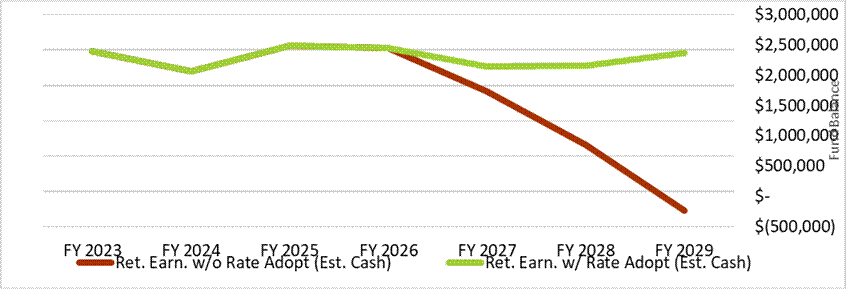
Wastewater Collection & Treatment Services: FY 2023 – FY 2029 (projected) Enterprise Fund Balance (Retained Earnings)
Rate Scenario Option 1: $500 - $600 Adjustments (Recommended) FY2027: $500 / FY 2028: $550 / FY 2029: $600
This next chart is an overview of the fund balance. Should rates remain the same and let expenses outpace revenues over the next three (3) fiscal years, or we can maintain the fund balance with the proposed rate scenario increase. This would be a $50 increase every year over the next three (3) fiscal years. The increases would be as follows: FY2027: $500 / FY 2028: $550 / FY 2029: $600
This would keep pace with expenditure increases and gets the fund to be self-sustaining.
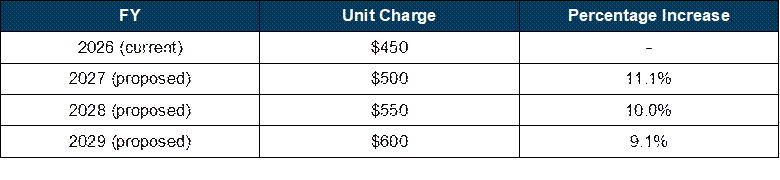
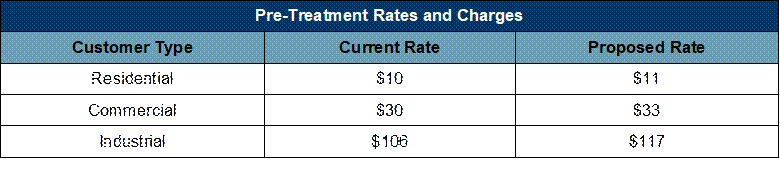
Wastewater Services Proposed Rate Adjustments (Recommended)
This shows the current rate and the proposed increases over the next three (3) years. The increase in
pre-treatment rates and charges, however, this is a small piece of the overall generating elements of the fund. These were not adjusted last time, and this would follow suit as finances warrant justification this time.
Summary of Proposed Recommendations
Peer Comparisons
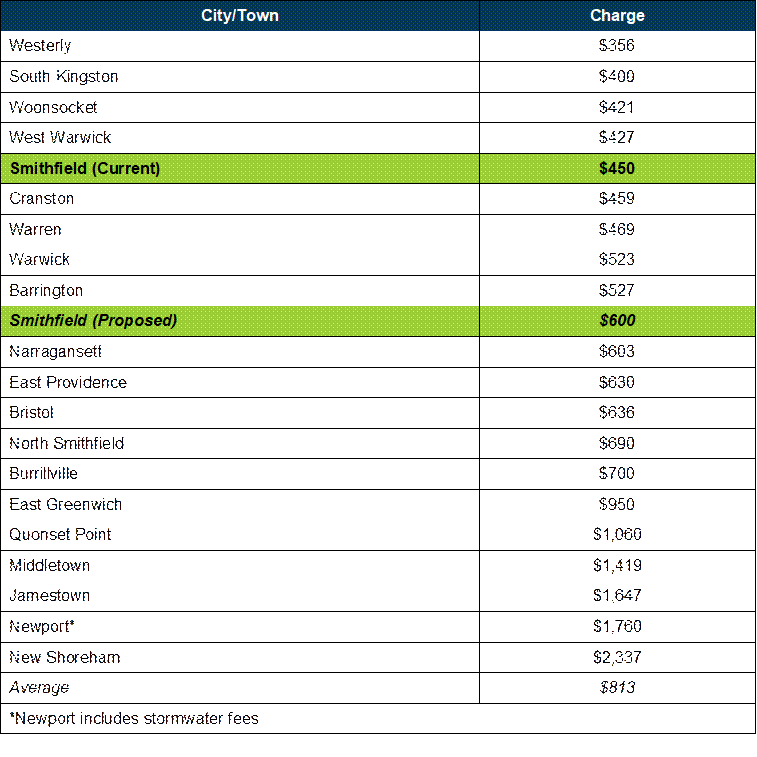
If we omit the bottom of this list, going from a rate of $450 to $600 three (3) years from now, will still keep the Town in the middle. It can be expected that some of these communities will do increases over the next three (3) years.
President Tassoni questions how much is in the reserve. Mr. Myott states that it is trending at approximately $2.2M, and out of a $5M projected expense environment, that will get the Town close to the industry standard of ninety (90) – one hundred (100) days of operational expenditures.
Member Iannotti states that there is an expense in our budget for $249,000 in FY27 for “transfers to the General Fund”, and questions what this is.
Mr. Myott explains the following: This is for indirect charges going back to the Town. The sewer fund is assessed indirect charges on an annual basis for Town management, legal, IT, etc. Whatever services support the Town, the Town charges the fund accordingly.
Member Iannotti questions if this reflects any additional debt owed to the Town. Mr. Myott explains this does not reflect any additional debt owed to the Town, it would be internal accounting.
Member Iannotti states that the way the billing is currently, it is a flat rate, and he questions if the flat rate goes up to a certain usage. Mr. Myott explains that a unit charge is approximately 70,000 gallons of water usage, and currently that customer would get assessed the $450 charge.
Member Toppi questions if we have the data on how many people go over and what they are paying. Mr. Myott explains the following: This data can be extracted from the billing system, and this is looked at. It is based on water consumption, because of the framework and how the billing system is set up. This is a very common framework. There is not an actual sewer usage monitoring meter.
Member Iannotti questions how you would know if there is no monitoring. Mr. Myott explains it is based on the water usage, and the water is metered, therefore, customers get charged by the gallons of water they use. Member Iannotti questions why we cannot have a system by which people are charged by their water usage like other communities. Mr. Myott explains that the system is based on 70,000 gallons of water usage.
Member Iannotti questions of a customer uses 70,001 gallons would they be paying double. Mr. Myott explains they would go up to the next rate charge. Mr. Myott explains that the distribution of the vast majority of our residential customers fall within that one (1) unit charge (60% - 70% fall in this charge).
President Tassoni questions what the profit margin is. Mr. Myott explains that there is no profit margin because it is less than 100%. Member Iannotti states it is a deficit.
Member Iannotti states that if the council adopts this recommendation, we will still have a $300,000 deficit next year without including depreciation. Mr. Myott confirms this and states that is the projection, and that was designed to give a little bit of relief to the ratepayers instead of going from $450 to $550 which is a significant increase.
Member Iannotti states that in year three (3), we are at $650, which is a $200 increase, and he questions spreading that out over three (3) years by doing a $67 increase per year. Mr. Myott explains the following: This could be done, however, looking at why it was chosen to go this route, the fund is at a healthy industry level at the moment, and you have the option to lean at that a little bit. We are seeing extreme swings on the expense side, and maybe things will be different three (3) years from now on the macroeconomic level than they are now, and you made need to “bump things up” anyway. The forecast now is telling us we can get away with a 50/50/50, and he felt that was the most equitable approach from a ratepayer standpoint. The council can certainly consider other scenarios.
Member Iannotti states that he is aware that the fund balance is an industry standard, and he questions if it was figured out that this is a safe fund balance considering the age of the facility and some of the things that could possibly happen.
Member Iannotti further states that the Town may not have the money if something happens in addition to the $2.2M we currently have. Mr. Myott explains the following: We are thinking closer to $2.5M by the time the Town reaches FY29, would be a closer alignment to account for some of those things that will undoubtedly come to its fruition as far as major repairs needed. This includes the scenario, even with just the 50/50/50, a level of pay as you go “baked” in there as well. That would be for smaller needs, and some are currently identified, that the staff will embark on annually to mitigate some of those significant repairs needed down the road. This is something that has not been funded to a full level in previous years, with that, we expect to get ahead of some of those things.
Member Iannotti states that we want to be ahead, and the Town has not had a rate increase in ten (10) years. Mr. Myott states that Town did great work with that scenario, and revenue projections were close to being spot on, however, the expense environment was unexpected.
Member Toppi questions if there is a reason why Lincoln, North Kingstown, and Johnston are not on the peer comparison list. Mr. Myott explains there is no reason, and this document is the latest list taken from a state document. Member Toppi states that Lincoln and North Kingstown is most comparable to us in terms of population, and she would be curious were they would stand. Mr. Myott offers to track that information, and questions if those other communities have a treatment plant because it would not be an apples to apples comparison. Member Iannotti thinks they are on the Narragansett Bay Commission.
Member Iannotti states that he noticed a drop in the capital reserve fund that is set aside, and he questions if there is a reason for that. Member Iannotti reviews the amounts. Member Toppi thinks that is the interest line. Member Iannotti questions if the capital reserve is the same as the fund balance or if it is separate. Engineer Jelley explains that the capital reserves come out of the fund balance, therefore, the Town has one (1) savings account with approximately $2.2M - $2.4M (every year the operational expenses and the capital reserve come out of that one (1) fund).
Member Iannotti states that the operational expenses starting in July 2027, will go up by approximately $360,000 because the Town is doing sludge and traffic control. Engineer Jelley explains the following: Last year we entered into a new contract with Veolia Water, previously this was a ten (10) year contract. During this new contract negotiation, it was concluded that the Town would take care of all costs associated with sludge removal offsite. He tracks this, and it is approximately $30,000 per month. This amount times three hundred sixty (360) is where that amount comes from. This is a new revenue expense that was not expected in the last sewer rate; therefore, it now needs to be addressed in this one. A contractual obligation for Veolia Water is that they have to clean a fifth of our collection system every year. When there are certain sections in Town that are busier areas, they require police detail for safety purposes.
Member Iannotti questions if the sludge goes to Woonsocket. Engineer Jelley explains the following: Every two (2) years they go out for a procurement process to get the best bid to ensure the Town gets the best price. The sludge could go to Woonsocket, Cranston, etc., and right now the sludge goes to Cranston.
President Tassoni questions the communities having the Narraganset Bay Commission and those having Veolia Water and what the difference is. Engineer Jelley explains that the Narraganset Bay Commission would be similar to the Town where they treat their wastewater and Veolia Water just operates the treatment plant and collection system; they are not an actual treatment plant.
Member Toppi questions the professional fees. Engineer Jelley explains this would be for any kind of services that come up such as emergencies, evaluations, and any additional services that are not under contract with them. Member Toppi questions, if the fees are not used would they go back into the General Fund. Engineer Jelley states that the money would go back into the Sewer Enterprise Fund. Engineer Jelley reviews graphs of different scenarios that illustrates would could happen with the optimal ninety (90) to one hundred (100) day window.
Member Iannotti questions the age of the system as opposed to some of the other systems that are around. Engineer Jelley explains the following: He is not sure about that in comparison to other areas, however, the pump stations are all original, and there have been capital improvement projects to improve them. He is currently working on evaluations of five (5) pumping stations in the Town for that reason. He is also to looking to address the sewer fund in ways that does not go on the taxpayer directly. Sewer permits have not been addressed since 1992, and there is a $40 fee for the first unit and $20 for each additional unit. He reached out to local communities to gauge how much their sewer fees are. It is his interpretation that the council can increase those fees.
Member Iannotti questions the council doing they consider increasing the permit fees when they consider raising the sewer rates. Engineer Jelley states that the sewer rates would need to take place before July which is when the bills come out.
President Tassoni questions if the council could do a one (1) year increase. Engineer Jelley states that council could do that; however, he would question the reasoning. President Tassoni was not sure if the permit fees would help. Engineer Jelley states that it may address it; however, not to the degree he is thinking, and the Town would only gain from the increase would be for a big development.
President Tassoni states that the biggest problem for him is the amount because the Town will have a 4% tax increase, and you do not know what it will be in the coming years. President Tassoni further states that we will tax people out of the Town. Engineer Jelley reminds the members that this is cheaper than owning a septic system because repairs are expensive and having the luxury of a properly operated sewer system is crucial.
President Tassoni expresses his concerns about single people living in condos who are paying just as much as two (2) or three (3) people living in a condo. Engineer Jelley reminds the members that although there is a $450 rate fee, it is based on a 70,000 gallons of annual water consumption. Engineer Jelley states that amount is outdated because people use more than that on a typical basis, and he is hoping to raise this about to 110,000 gallons which is more of an industry standard. Engineer Jelley further states that even though we would have a rate increase more people would fall within that initial allotment (82%). Member Iannotti states that this does not address the fairness issue and suggests breaking it up into smaller units having a smaller charge per unit. Engineer Jelley references Page 20 showing an analysis of this and states that because of the new contract obligations, it increased the cost of operating, and he wants to tackle securing the balance fund and what it is projected to be going forward.
Member Toppi states that all the communities listed on the peer report having a flat rate and questions how many communities in the state are based on usage consumption. Mr. Myott explains that even with the flat rate unit structure, it is by far the most common framework because it is simplistic from an administrative and billing standpoint.
Mr. Myott further explains that once you add complexity, either tiers or other sophisticated divisions of the billing framework, you must consider the administrative burden, billing system capacity, and added expenses for the billing system.
Vice President Bovis thinks that 70,000 gallons of water sounds like a great deal. Mr. Myott explains that in “water speak” it goes by a metric of one hundred (100) cubic feet of water equals seven hundred forty-eight (748) gallons, which is the basis for all of these calculations.
Vice President Bovis questions if there is a way to do tiers. Mr. Myott explains this could be done, but you must consider the capacity to bill like that, and as of right now the Town could get away with a simplistic tiered structure. Mr. Myott further explains that anything more complicated than that would require looking at the Town’s software capacity and more staff power.
Member Iannotti states you are already determining the water usage and questions why is this a large calculation to have more tiers. Mr. Myott explains that following: It comes with system and software set up to track those things, and you would be sending out a larger variety of different bills. Moving towards a tier, if that is a consideration, it must be simplistic. You are designing it to push it to your high users, and once you cross over to the third tier, you are ramping up the rates. That is usually the way those tier tables are designed.
DPW Director and Water Commissioner, Gene Allen, explains the following; On the water side they do exactly what is being discussed, and it is not complicated. They do all the readings and every month NBC calls them, and they give them the readings. They use CUSI which is the billing system they have moved to. He gives the members an overview of how the system works and its functions.
Engineer Jelley states the following: He would like to look into this; however, with the time constraint and looking at how we have to do this admiratively, there are other things that need to be reviewed and that will take time. Preferably he would like to do a flat rate for this three (3) year cycle and this would give him time to ensure things are done properly with the conversion for the next time around. He thinks consumption is fairer and better in general. President Bovis questions if one (1) year would give Engineer Jelley enough time if the council were to approve this in phases. Engineer Jelley states that because he does not know the backend, that is a difficult question to answer.
C. Public Comment:
Edward DeMayo, 75 Whipple Road, thinks that with the right software, this could be done simply.
D. Adjournment:
Motion is made by Member Toppi, seconded by Member Toppi, to adjourn the meeting.
Meeting adjourns at 6:32 p.m.
________________
Town Clerk